
What does it mean to "Lift Heavy Sh$t?"

The gym can be an overwhelming and intimidation place. Finding a program that works for you is key!
“Bekah, what does it mean to Lift Heavy?” Quick reminder, I work full time as both a NASM certified personal trainer AND a Professional Mountain Bike Coach (Level 2 PMBIA). Today, I want to cover 3 things:
1) What it means to “lift heavy sh$t” (LHS)
2) The Why behind the term LHS
3) How to build muscle
I receive the “lift heavy“ question almost daily. Especially amongst women 40+. The terms, “Lifting Heavy,” or, “Lift Heavy Shit,” or “LHS” have developed a lot of buzz the past few years. Much of the buzz is actually science backed evidence brought into the public eye due to the tremendous work of researchers and clinicians such as Dr. Stacy Sims, Dr. Marie Claire Haver, and Dr. Stephanie Estima. Researchers have found that as women enter into the perimenopause years, building muscle helps with 3 key things:
1) Preserving Metabolism and Body Composition
As estrogen levels decline, women naturally lose lean muscle mass and gain fat mass, even if their weight stays the same.
Muscle is metabolically active tissue—more muscle helps maintain a higher resting metabolic rate, which supports healthy body weight and energy balance during hormonal changes.
2) Support Bone Density and Reduce Fracture Risk
Strength training stimulates bone remodeling and helps slow or prevent the bone density loss that accelerates during perimenopause and menopause.
Improved bone density reduces the risk of osteoporosis and fractures, which become more common as estrogen declines.
3) Improving hormone balance, mood, and overall resilience
Resistance training improves insulin sensitivity, supports thyroid function, and can help buffer some of the metabolic and mood fluctuations linked to hormonal changes.
Regular strength work is also linked to better sleep, reduced anxiety and depression, and improved confidence and vitality—key factors for quality of life during this transition.
OK cool! I want all of the above and you do too? Yes? Note, the key to produce the above mentioned benefits: build muscle. NOT, Lift Heavy. Just as there is more than one way to skin a cat, there is more than one way to build muscle. Lifting heavy weights is ONE way to build muscle. But if you were to walk into a gym today, with little to no history, experience, or knowledge of how to lift weights, and immediately start lifting heavy, there’s a very high likelihood of injury and soon the only thing you’d be lifting would be the remote while you recover on the couch. So from now on, when you hear the term “Lift Heavy” I want you to think “build muscle.” So let’s look at the 3 key factors to build muscle. Ready?
How to Build Muscle:
1) Progressive resistance training
This is your foundation of muscle growth.
What it means: Gradually increasing the load (weight), volume (sets × reps), or intensity (time under tension) of strength exercises over time.
Why it works: Muscle fibers grow when they’re repeatedly challenged beyond their comfort zone, forcing adaptation.
How to apply it:
Train 2–4 times per week with major compound lifts (squats, deadlifts, rows, presses) plus accessory work.
Use progressive overload — small weekly increases in weight or reps.
Include lower-body focus (glutes, quads, hamstrings) since these muscles are key to bone health and metabolic rate.
2) Prioritize protein timing and total intake
Muscle growth depends on adequate protein to drive repair and synthesis.
Target: ~1.6–2.2 g of protein per kg of body weight per day.
Distribute evenly: Aim for 25–35 g of protein per meal, ideally every 3–4 hours.
Include leucine-rich sources (whey, eggs, meat, fish) — leucine triggers muscle protein synthesis.
3) Prioritize recovery and hormonal support
Muscle growth happens during rest — not during the workout.
Sleep: 7–9 hours per night supports growth hormone and recovery.
Stress management: Chronic cortisol elevation (common in perimenopause) blunts muscle gains and increases fat storage.
Include recovery days: Light movement, yoga, walking, or mobility work help reduce inflammation and support muscle repair.
Micronutrients: Ensure adequate vitamin D, magnesium, and omega-3s to support muscle and hormone function.
How to do I know if my workout is targeting muscle growth?


The most common confusion I encounter behind the term, “Lift Heavy Shit (LHS)” is in contrast to other forms of exercise. I hear a lot of comments such as, “I have weights in my circuit class. My spin class uses dumbbells! My booty camp uses KBs and I leave exhausted!”
That’s all great. But what is your desired outcome? If you have bought into the logic behind the importance of lifting heavy shit (remember, build muscle! then let me help ensure you’re using your time efficiently and can reap the rewards of all your sweat equity.
The top 3 things to look for in a true progressive resistance training program:

#1) You are following a program, not just bouncing from YouTube vid to magazine workout to Instagram trend to Billy Blanks.
#2) Progressive Overload - your program should utilize progressive overload and have you perform the same exercise for at least 4 weeks and slowly increase the load or difficulty of that exercise. This means adding weight, adding reps, or adjusting tempo in order to increase the time under tension or create a greater muscle building stimulus.
#3) Rest time - true strength and muscle building workouts will have rest times of up to 3 minutes between sets! If the program you’re following only has you resting for :20-:30 seconds between sets or movements you can chalk that program up to a circuit or HIIT style of workout, not strength.
#4) RPE or 1-3 Rep Max Tests. Strength workouts should have you operating between a 7-9 on a Rate of Perceived Exertion (RPE) scale where 10 = max effort and 1 = a very easy effort. If your lungs are the limiting factor of your workout, not your muscles, there’s a good chance your workout is creating more of a cardio stimulus than a muscle building stimulus.
#5) Track progress - a few examples: you will know if you’re building muscle if you can do more push ups today than you could 1 year ago, or if you can lower yourself down to the ground on 1 leg slower today than 1 year ago, or if you can press a 20# DB over head 12 times and last year you could only do it 9 times. Remember, building muscle take YEARS of consistent effort.
If your workout class or program has you bouncing from one activity to the next, doesn’t track reps or load, and does not incorporate focused and structured rest time, you are most likely targeting your cardiovascular system more than your musculoskeletal system. As mountain bikers, and active humans in general, it’s important to improve both strength and aerobic capacity. But in my professional opinion, it is best to have your strength work focus on strength, and your cardio work focus on cardio. There will always be crossover benefits, but what frustrates me are circuit classes that sell themselves as strength work but are truly more of a glamorous cardio workout with weights. To be perfectly honest, a lot of strength training can seem boring. It’s the same or similar movements over and over and over again. But if you do them consistently, and add subtle variations, not only will you get stronger, but you won’t be bored. In fact, you’ll find yourself more and more engaged as you both build more strength and improve your mind-body connection!
If you regularly switch between programs, erratically attend workout classes or do whatever workout you can find in thirty seconds on YouTube, you’re going to struggle to truly build muscle and strength. If you truly want to build more muscle, the most, THE MOST important thing, is CONSISTENCY. If you are consistent in your workouts and you follow a well designed program, you WILL build strength. This means you pick a plan that meets the above criteria and you stick with it. Building strength takes years.
What if you want to build muscle but…
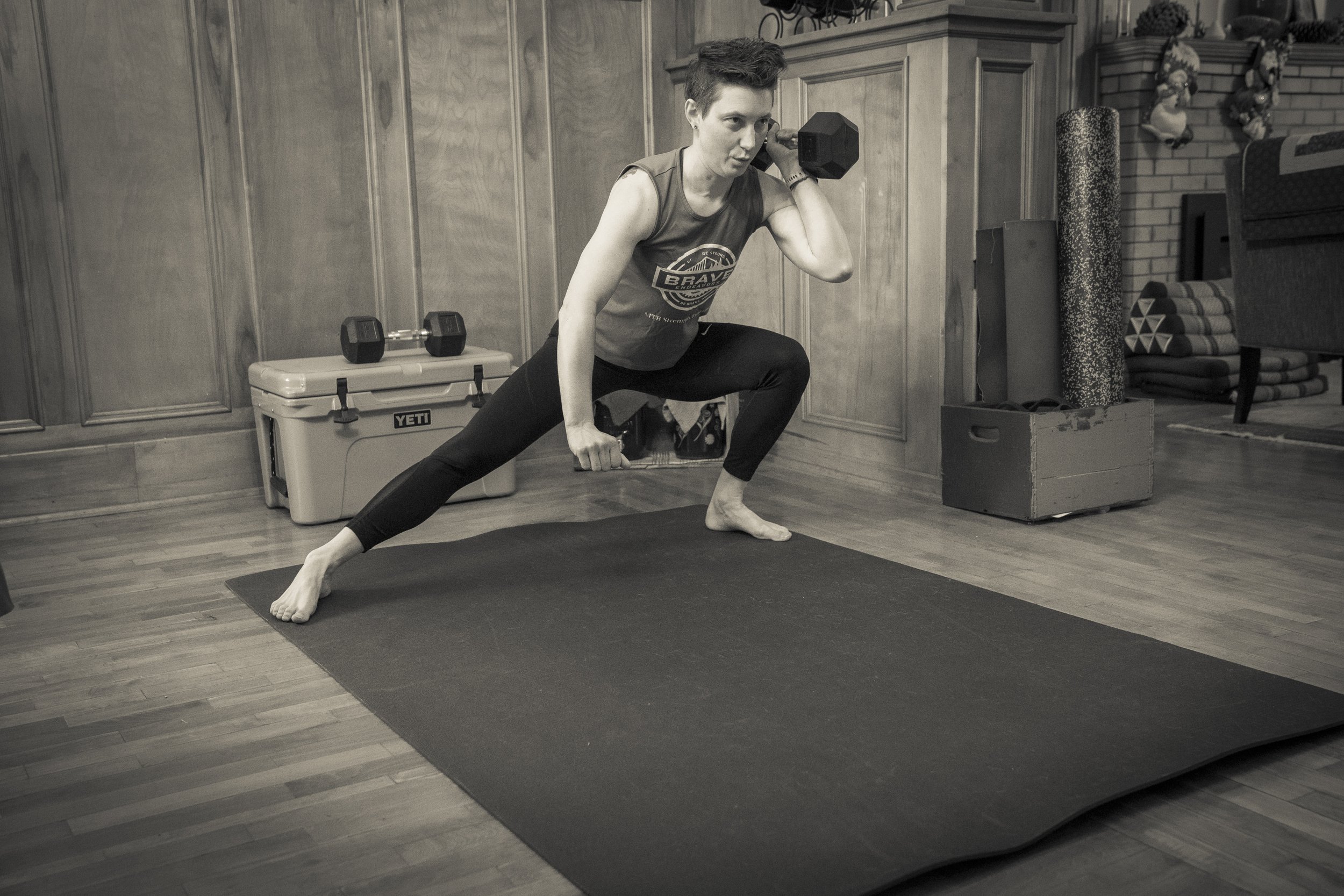
You don’t have access to a gym
Don’t want to go to a gym
Don’t know how to properly and safely perform compound movements such as barbell deadlifts and squats.
Can you build muscle without using heavy weights!
A well designed program will incorporate variables such as exercise selection, intensity, rest time, and tempo to give you the maximum strength and muscle you seek. But remember, you need to consistently show up and put in the work.
The primary reason I developed buildCLASS Strength Training for mountain bikers, is to provide a strength based program that revolves around simple to use equipment such as 2 dumbbells and a cooler! If you are interested in checking out buildCLASS: go ahead and use code BUILDSOLODEMO to get started with your first month at no cost.
In conclusion, to lift heavy weights means to perform a workout where the desired outcome is to build muscle or increase strength. It is NOT to improve your cardio or aerobic fitness, although those are nice byproducts. You do not have to go to a gym or work with a barbell in order to “lift heavy weights.” You can follow a well designed program, like buildCLASS, that incorporates intentional exercise selection, tempo and intensity so you can focus on building strength that will reap benefits for years to come.
I hope you found this helpful. Please let me know if you have any questions.
-Bekah Rottenberg, NASM Certified Personal Trainer and professional Mountain Bike Coach